









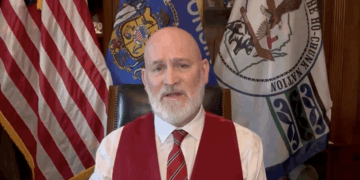








On Friday, Rep. Tom Tiffany and Rep. Tony Wied introduced the “Oversight for Members And Relatives Act,” better known as the OMAR Act.
The bill (H.R. 7304) is targeted to rewrite federal campaign rules meant to prevent candidates and officeholders from routing campaign money to their spouses, and to force clearer disclosure when campaign committees pay other close relatives.
The bill amends the Federal Election Campaign Act by creating a new law that a candidate’s authorized committee, and most other committees established, maintained, or controlled by a candidate or federal officeholder, may not directly or indirectly compensate the candidate or officeholder’s spouse for services performed for the committee.
The bill also adds a transparency requirement. Committees covered by the bill would have to include a separate statement in their regular campaign finance reports listing any payments, including compensation, made to the spouse or any “immediate family member” during the reporting period. The bill defines “immediate family member” as including children, parents, siblings, in-laws, and grandchildren.
The OMAR Act changes how members are disciplined. If a covered committee violates the spouse-compensation ban and the candidate/officeholder knew about it, any civil penalty would be imposed on the candidate/officeholder rather than the committee, and the committee would be barred from reimbursing that penalty. The bill would apply to payments made on or after the date of enactment.
The OMAR Act is aimed at a long-running loophole of campaign finance law. Federal law bans converting campaign funds to “personal use,” the line can get blurry when campaigns hire relatives or pay a spouse for “services.” Current rules focus on whether a payment would exist “irrespective of the campaign,” and they generally allow real campaign expenses even if the campaign has a personal connection. (RELATED: “Our Government is a Mess” Wisconsin Farmer Announces Secretary of State Bid)
The “OMAR” branding refers to Rep. Ilhan Omar and her campaign’s payments to a political consulting firm led by her now-husband. In Matter Under Review (MUR) 7639, the Federal Election Commission found “no reason to believe” the respondents violated the ban on converting campaign funds to personal use, though it also directed the committee to work with the agency to correct aspects of reporting.
(RELATED: New Richmond Schools Face Title IX Flashpoint Over Girls’ Locker Room Privacy)