















On Good Friday, Wisconsin Governor Tony Evers quietly vetoed a bill that would have required pornography websites to verify the ages of their users — siding with the adult film industry and the ACLU over a bipartisan legislative majority and the parents of Wisconsin children.
The legislation, mirroring laws already on the books in 25 states, would have banned pornography distributors from operating in Wisconsin unless they deployed what the bill described as “a reasonable age verification method” to confirm users are not minors. Operators would have been explicitly prohibited from retaining user data after verification — a provision sponsors said went further than similar laws in other states in protecting user privacy.
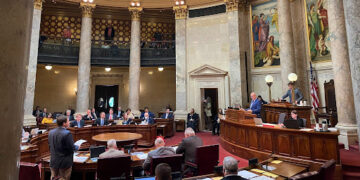
The bill cleared the Wisconsin State Assembly 69-22 in March 2025, with nearly two dozen Democrats crossing the aisle to support it. It passed the State Senate on a voice vote with only a single Democrat on record in opposition — a level of bipartisan support rare in today’s political climate.
Evers framed his veto as a privacy protection, arguing the bill creates an “intrusive burden on adults who are trying to access constitutionally protected materials” and that it fails to prevent operators from selling user data to third parties such as data brokers or the government.
“This is a violation of personal privacy,” he wrote in his veto message. (RELATED: Wisconsin Conservative Turnout Catastrophe Delivers Taylor A Historic Supreme Court Blowout)
Republican co-author Sen. Van Wanggaard (R-Racine) pushed back hard, noting the bill explicitly bans operators from knowingly retaining verification data. “The website must verify the age, and then delete the data,” Wanggaard said. He added that anyone harmed by a data breach would retain the right to seek damages.
Wanggaard didn’t mince words about the governor’s decision. “By hiding his veto on Good Friday, he knows he and (Democrats) are out of step with 70-80% of Wisconsinites, and Republicans and Democrats in dozens of other states that see this bill as an important tool to protect kids from harmful images,” he said.
Supporters of the bill argued the legislation addressed a genuine crisis facing Wisconsin families. Republican co-author Rep. Joy Goeben testified in October that the landscape of online pornography bears no resemblance to the past.
“Porn is no longer a dirty magazine found under a mattress. It’s pervasive, hardcore, and easily accessible and it targets our youngest generation to hook them early and keep them addicted,” Goeben told colleagues. (RELATED: Universal Child Care For Families Earning Up To $500k? Wisconsin Lt. Gov. Rodriguez’s Vague Plan Raises More Questions Than Answers)
The Wisconsin Catholic Conference put the issue in stark terms. “What makes online pornography so different today than in the past is that viewers don’t have to go looking for it,” associate director David Earleywine testified. “Without meaningful restrictions, children are carrying poison in their phones.”
Evers’ veto came despite a 6-3 U.S. Supreme Court ruling in 2025 upholding a nearly identical Texas law — providing clear constitutional cover for the Wisconsin legislation. The high court’s decision removed the primary legal argument opponents had used to challenge such measures nationwide.
The bill was opposed by the ACLU of Wisconsin and the Free Speech Coalition, which represents businesses in the adult film industry. The ACLU acknowledged being “sympathetic to the overarching goal” of protecting children but argued the privacy trade-off was unacceptable. The Free Speech Coalition claimed such laws push users toward websites hosting illegal content — an argument critics noted benefits the industry financially.
Critics noted the governor offered no timeline, no legislation, and no concrete plan — leaving Wisconsin children unprotected while 25 other states have already acted.