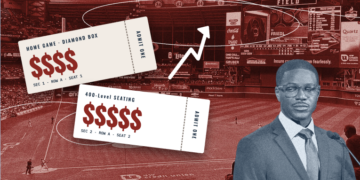











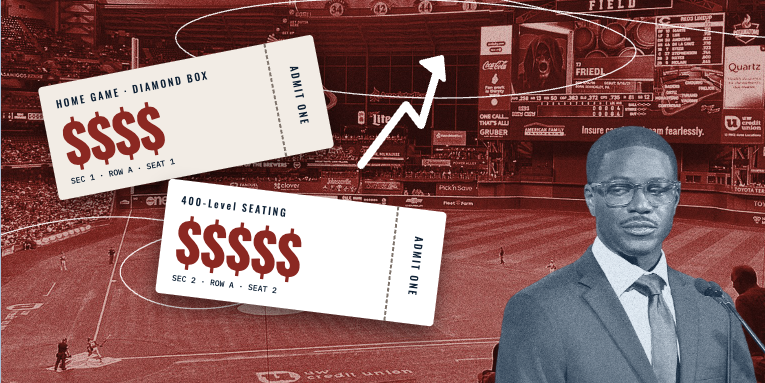
MILWAUKEE — Milwaukee County Executive’s, including gubernatorial candidate David Crowley, championed higher sales taxes and helped negotiate a publicly funded stadium deal to keep the Brewers in Milwaukee through 2050. Three years later, residents are paying those higher taxes while tickets to see their hometown team in the World Series cost more than $3,000 apiece.
The lowest available resale ticket for Game 1 of the World Series at American Family Field reached $3,107 Tuesday, approaching the $3,361 get-in price recorded ahead of this year’s Super Bowl.
For a Milwaukee family of four, attending the first World Series game in 44 years could cost more than $12,400 in tickets alone.
The prices underscore an uncomfortable contradiction for Milwaukee taxpayers: They are helping support the stadium that keeps the Brewers in town, but many cannot afford to walk through its gates for the franchise’s biggest games.
And unlike a World Series ticket, the public’s financial commitment isn’t optional.
Taxpayers Bear the Cost, Whether They Attend or Not
The fundamental question is not whether the Brewers deserve to remain in Milwaukee. It is what residents should expect when their tax dollars help preserve a privately operated professional sports franchise.
In July 2023, Crowley urged Milwaukee County supervisors to approve a 0.4-percentage-point sales-tax increase, arguing that the additional revenue was necessary to stabilize county finances and address looming budget deficits.
The County Board approved the increase 15–3, raising the county sales-tax rate from 0.5% to 0.9% beginning January 2024. The higher tax was projected to generate approximately $82 million in additional annual revenue, largely to address the county’s pension obligations. Milwaukee city residents simultaneously faced a new 2% city sales tax, pushing their combined state and local sales-tax rate to 7.9%.
Months later, Crowley supported a separate agreement providing $500.8 million in public funding to renovate and maintain American Family Field. The deal committed $365.8 million in state funding and required Milwaukee County and the City of Milwaukee to contribute $67.5 million each. For Milwaukee County, that means $2.5 million annually through 2050, subject to the agreement’s contribution limit.
The stadium legislation did not create the county’s sales-tax increase, which was approved earlier for separate financial purposes. Nevertheless, both measures represent significant fiscal decisions Crowley supported during the same year.
Residents now face higher taxes on everyday purchases while their local governments have also committed public resources to the stadium.
Crowley defended the stadium agreement in November 2023, saying it would retain the Brewers while providing an estimated $239 million in additional revenue flexibility for Milwaukee County.
He said the deal would keep the Brewers in Wisconsin “without any additional impact on local taxpayers.”
But even when stadium financing does not require another tax-rate increase, it still involves public money. The county’s annual stadium contribution is a commitment of government resources that cannot simultaneously be spent on other priorities.
Public officials justified the stadium agreement as an investment in economic development, tourism, jobs and the long-term financial health of the region.
Those benefits matter. Brewers games bring visitors downtown, support hotels and restaurants, and generate economic activity.
But those broader economic benefits offer little consolation to a family looking at a five-figure bill to watch the Brewers compete for their first World Series championship.
Milwaukee residents pay sales taxes whether they watch every game, attend once a season or never set foot inside American Family Field.
They contribute to the public financial framework supporting the stadium without receiving any corresponding guarantee of affordable tickets.
And while the Brewers’ historic championship run has demonstrated the franchise’s value to the city, it has also highlighted the separation between the people helping fund its home and the customers who can afford its most coveted seats.
Crowley’s administration argued that keeping the Brewers would deliver long-term financial advantages for Milwaukee County. The county sales-tax increase, meanwhile, was presented as necessary to preserve essential public services.
Both decisions came with promises of broader public benefits.
Now, with World Series tickets reaching thousands of dollars, the question is whether those benefits extend meaningfully to the residents footing the bill.
Tickets Rivaling the Super Bowl
Milwaukee’s long-awaited return to the World Series has sent ticket prices soaring.
The Brewers, who won a franchise-record 103 games before sweeping the Los Angeles Dodgers in the National League Championship Series, are making their first World Series appearance since 1982.
Demand has pushed resale prices toward levels rarely seen in professional baseball.
According to TicketData.com figures reported by Reuters, the cheapest available ticket for Friday’s opener reached $3,107 Tuesday, more than the previous World Series record get-in price of $1,809, set during the Chicago Cubs’ 2016 championship run.
Game 2 tickets in Milwaukee started at $2,748. By comparison, tickets for Game 3 in St. Petersburg, Florida, started at $766.
That means fans could potentially purchase a ticket to see the Brewers play on the road for roughly one-quarter of the cost of attending Game 1 in Milwaukee.
While secondary-market sellers are responsible for many of the eye-watering resale prices, even tickets offered directly to certain season-ticket holders were expensive.
Milwaukee Magazine reported World Series ticket offers starting at $937 for upper-deck seats, $1,322 for bleachers and $1,872 for club-level seating.
Milwaukee Kept Its Team. But at What Cost?
Stadium financing agreements are frequently defended on the grounds that losing a professional sports franchise would impose lasting economic and cultural costs on a city.
Milwaukee secured its team for another generation.
For Crowley and other officials who supported the deal, that was a significant achievement.
But keeping the Brewers in Milwaukee is not the same as ensuring Milwaukee residents can afford to see them.
The team has every commercial incentive to capitalize on unprecedented World Series demand. Resale marketplaces similarly reflect what buyers are willing to pay.
That is how ticket markets operate.
But the stadium supporting those transactions benefits from public contributions that are not determined by an individual’s ability or desire to attend a game.
Milwaukee residents have already accepted higher sales taxes. Their governments have committed hundreds of millions of dollars in additional public funding to maintain the ballpark.
And now, at the moment fans have waited more than four decades to experience, many are being priced out.
Crowley helped secure the Brewers’ future in Milwaukee at the steep expense of the taxpayer.
Whether Milwaukee’s taxpayers can afford to be part of that future is an entirely different question.