




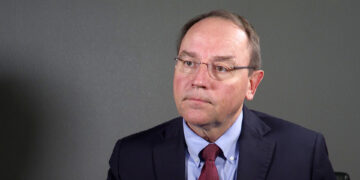
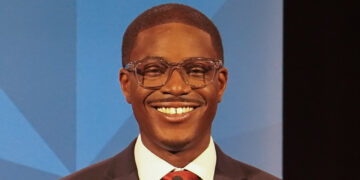
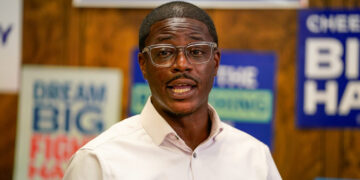
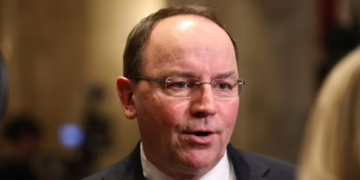



The five remaining Democratic candidates for Wisconsin’s governorship had their first and only primary debate before the election in August.
The candidates, Mandela Barnes Joel Brennan, David Crowley Francesca Hong and Kelda Roys met on Tuesday at Marquette University ahead of the August 11th primary. In the debate, the candidates all found common ground on progressive priorities.
In a discussion about the state’s projected budget surplus, candidates weighed various ideas for how to spend it. Earlier this year, there was a bi-partisan proposal that would have earmarked $1.8 billion for rebates, tax relief, special education funding, and eliminating state taxes on tips and overtime. (RELATED:Madison’s Body-Camera Failure Looms Over Fatal Police Shooting)
This bill had the support of the legislative Republicans, Assembly Democrats, and Tony Evers, but was shut down after Senate democrats prevented its passing. Of the candidates on stage, only David Crowley said he would’ve signed it. The other candidates preferred holding or redirecting the money toward longer-term government programs.
In the debate, the candidates had diverging opinions on whether Wisconsin’s state income tax should be raised. Socialist Francesca Hong said she supports raising Wisconsin’s top rate from 7.65% to 8.65%. However, Hong co-authored legislation that would eventually impose a 17.7% marginal rate on taxable income. Candidate Joel Brennan said that the excessive reliance on higher taxes could drive wealthy residents and investment out of Wisconsin. (RELATED:Marquette Poll Reveals Chaos in Wisconsin Democratic Governor’s Race)
The candidates also competed over how aggressively to restrict data centers. Brennan proposed pausing new construction during his first 100 days, while Hong called for a full moratorium until new enforcement mechanisms are established. Citing concerns about electricity, water consumption and large subsidies. At an earlier Democratic forum, Crowley proposed a “Green New Deal” for public schools. Hong supported a carbon tax, a state-backed green bank and a requirement that Wisconsin produce all its electricity from renewable sources by 2040.